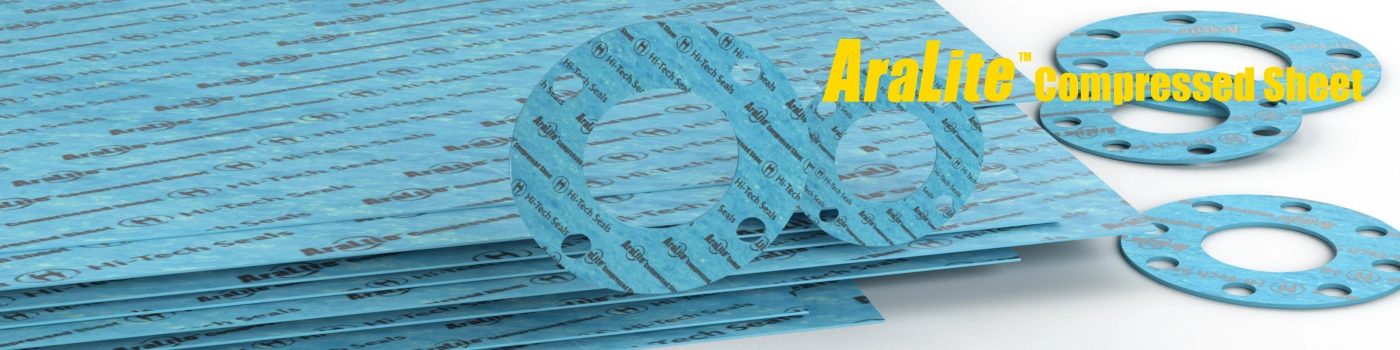
AraLite aramid compressed sheet gasket material for oil and gas by Hi-Tech Seals

AraLite™ Compressed Sheet Gasket Material

AraLite™ is Hi‑Tech Seals’ high‑quality, general‑purpose compressed non‑asbestos sheet gasket material, engineered for demanding industrial sealing applications. It is made from high‑strength aramid fibers and inorganic fillers, bonded with a nitrile (NBR) binder, which is a synthetic rubber with excellent resistance to oils, fuels, and many industrial fluids. AraLite™ delivers an outstanding combination of thermal, mechanical, and chemical resistance, making it a reliable, cost‑effective choice for engineers and maintenance teams in oil & gas, HVAC, and a wide range of industrial applications.

AraLite™ Key Material Specifications

The table below outlines key AraLite™ compressed non‑asbestos gasket sheet specifications to support quick material comparison. For more detailed technical information about AraLite™, please contact Hi‑Tech Seals.

SpecificationDetails
ColourBlue
CompositionAramid Fiber + Inorganic Fillers + Nitrile Binder
Thickness Range1/64″ to 1/4″
Operating Temperature °C (°F)-200 to 250 (-328 to 482)
Pressure Range psi (MPa)Vacuum to 1,450 (10)
Approvals and ComplianceABS, DVGW DIN 30653, SVGW DIN 3535-6, BAM (oxygen), EC 1935/2004, TZW W270, AGA AS 4623, DVGW DIN 3535-6, TA Luft (VDI 2440), DNV GL, ELL (hot), WRAS

AraLite™ Compressed Sheet Advantages

  • Excellent sealing capability
  • Good compressibility and recovery
  • Remarkable thermal resistance
  • Superior mechanical and chemical properties
  • Exceptional performance in contact with gas
  • Excels in a wide range of applications
  • Wide temperature range

Markets and Industries

  • General-Purpose
  • Oil & Gas
  • Treaters
  • Valves
  • Compressors and Pumps
  • Automotive
  • Heating Systems
  • Refrigeration and Cooling
  • Potable Water and Wastewater

AraLite™ Chemical Resistance Table

The table below summarizes the chemical resistance of AraLite™ compressed non‑asbestos gasket sheet and is provided as a general guide only to assist in selecting a suitable gasket material for industrial applications.

✓ Recommended
● Recommendation depends on operating conditions
✗ Not recommended
Acetamide✓
Acetic acid, 10%✓
Acetic acid, 100% (Glacial)✓
Acetone●
Acetonitrile✗
Acetylene (gas)✓
Acid chlorides✗
Acrylic acid●
Acrylonitrile✗
Adipic acid✓
Air (gas)✓
Alcohols
Aldehydes●
Alum✓
Aluminium acetate✓
Aluminium chlorate●
Aluminium chloride✓
Aluminium sulfate✓
Amines✗
Ammonia (Gas)✓
Ammonium bicarbonate✓
Ammonium chloride✓
Ammonium hydroxide✓
Amyl acetate●
Anhydrides●
Aniline✗
Anisole●
Argon (gas)✓
Asphalt✓
Barium chloride✓
Benzaldehyde✗
Benzene✓
Benzoic acid●
Bio-diesel✓
Bio-ethanol✓
Black liquor●
Borax✓
Boric acid✓
Butadiene (gas)✓
Butane (gas)✓
Butyl alcohol (Butanol)✓
Butyric acid✓
Calcium chloride✓
Calcium hydroxide✓
Carbon dioxide (gas)✓
Carbon monoxide (gas)✓
Castor oil✓
Cellosolve●
Chlorine (dry)✓
Chlorine (in water)●
Chlorine, <0.5% in water✓
Chlorobenzene●
Chloroform●
Chloroprene●
Chlorosilanes✗
Chromic acid●
Citric acid✓
Copper acetate✓
Copper sulfate✓
Creosote●
Cresols (Cresylic acid)✗
Cyclohexane✓
Cyclohexanol✓
Cyclohexanone●
Decalin✓
Dextrin✓
Dibenzyl ether●
Dibutyl phthalate●
Diesel oil✓
Diethyl ether✓
Dimethylacetamide (DMA)●
Dimethylformamide (DMF)●
Dioxane✗
Diphyl (Dowtherm A)✓
Esters●
Ethane (Gas)✓
Ethers●
Ethyl acetate●
Ethyl alcohol (Ethanol)✓
Ethyl cellulose●
Ethyl chloride (gas)●
Ethylene (gas)✓
Ethylene glycol✓
Formaldehyde (Formalin)✓
Formamide●
Formic acid, 10%✓
Formic acid, 85%●
Formic acid, 100%✗
Freon-12 (R-12)✓
Freon-134a (R-134a)✓
Freon-22 (R-22)✓
Fruit juices✓
Fuel oil✓
Gasoline✓
Gelatin✓
Glycerine (Glycerol)✓
Glycols●
Helium (gas)✓
Heptane✓
Hydraulic oil (Mineral)✓
Hydraulic oil (Glycol based)✓
Hydraulic oil (Phosphate ester-based)●
Hydrazine✓
Hydrocarbons✓
Hydrochloric acid, 10%●
Hydrochloric acid, 37%✗
Hydrofluoric acid, 10%✗
Hydrofluoric acid, 48%✗
Hydrogen (gas)✓
Iron sulfate✓
Isobutane (Gas)✓
Isooctane✓
Isoprene✓
Isopropyl alcohol (Isopropanol)✓
Kerosene✓
Ketones●
Lactic acid✓
Lead acetate✓
Lead arsenate✓
Magnesium sulfate✓
Maleic acid✓
Malic acid✓
Methane (Gas)✓
Methyl alcohol (Methanol)✓
Methyl chloride (Gas)●
Methyl ethyl ketone (MEK)●
Methylene dichloride●
Milk✓
Mineral oil type ASTM 1✓
Motor oil✓
N-Methylpyrrolidone (NMP)●
Naphtha✓
Nitric acid, 10%✗
Nitric acid, 65%✗
Nitrobenzene✗
Nitrogen (Gas)✓
Nitrous gases (NOx)●
Octane✓
Oils (Essential)●
Oils (Vegetable)●
Oleic acid✓
Oleum (Sulfuric acid, fuming)✗
Oxalic acid✓
Oxygen (gas)✓
Palmitic acid✓
Paraffin oil✓
Pentane✓
Perchloroethylene●
Petroleum (Crude oil)✓
Phenol (Carbolic acid)✗
Phosphoric acid, 40%✓
Phosphoric acid, 85%✓
Phthalic acid✓
Potassium acetate✓
Potassium bicarbonate✓
Potassium carbonate✓
Potassium chloride✓
Potassium cyanide✓
Potassium dichromate●
Potassium hydroxide●
Potassium hydroxide, 20%, 80°C✓
Potassium iodide✓
Potassium nitrate✓
Potassium permanganate●
Propane✓
Propylene (gas)✓
Pyridine✗
Salicylic acid✓
Seawater/brine✓
Silicones (oil/grease)✓
Soaps✓
Sodium aluminate✓
Sodium bicarbonate✓
Sodium bisulfite✓
Sodium carbonate✓
Sodium chloride✓
Sodium cyanide✓
Sodium hydroxide●
Sodium hydroxide, 50%, rt✓
Sodium hypochlorite (Bleach)●
Sodium silicate (Water glass)✓
Sodium sulfate✓
Sodium sulfide✓
Starch✓
Steam✓
Stearic acid✓
Styrene●
Sugars✓
Sulfur✓
Sulfur dioxide (Gas)●
Sulfuric acid, 10%✓
Sulfuric acid, 20%✗
Sulfuric acid, 98%✗
Sulfuryl chloride✗
Tar✓
Tartaric acid✓
Tetrahydrofuran (THF)✗
Titanium tetrachloride✗
Toluene✓
2,4-Toluenediisocyanate●
Transformer oil (Mineral type)✓
Trichloroethylene●
Vinegar✓
Vinyl chloride (gas)✗
Vinylidene chloride✗
Water✓
White spirits✓
Xylenes✓
Xylenol✗
Zinc sulfate✓